
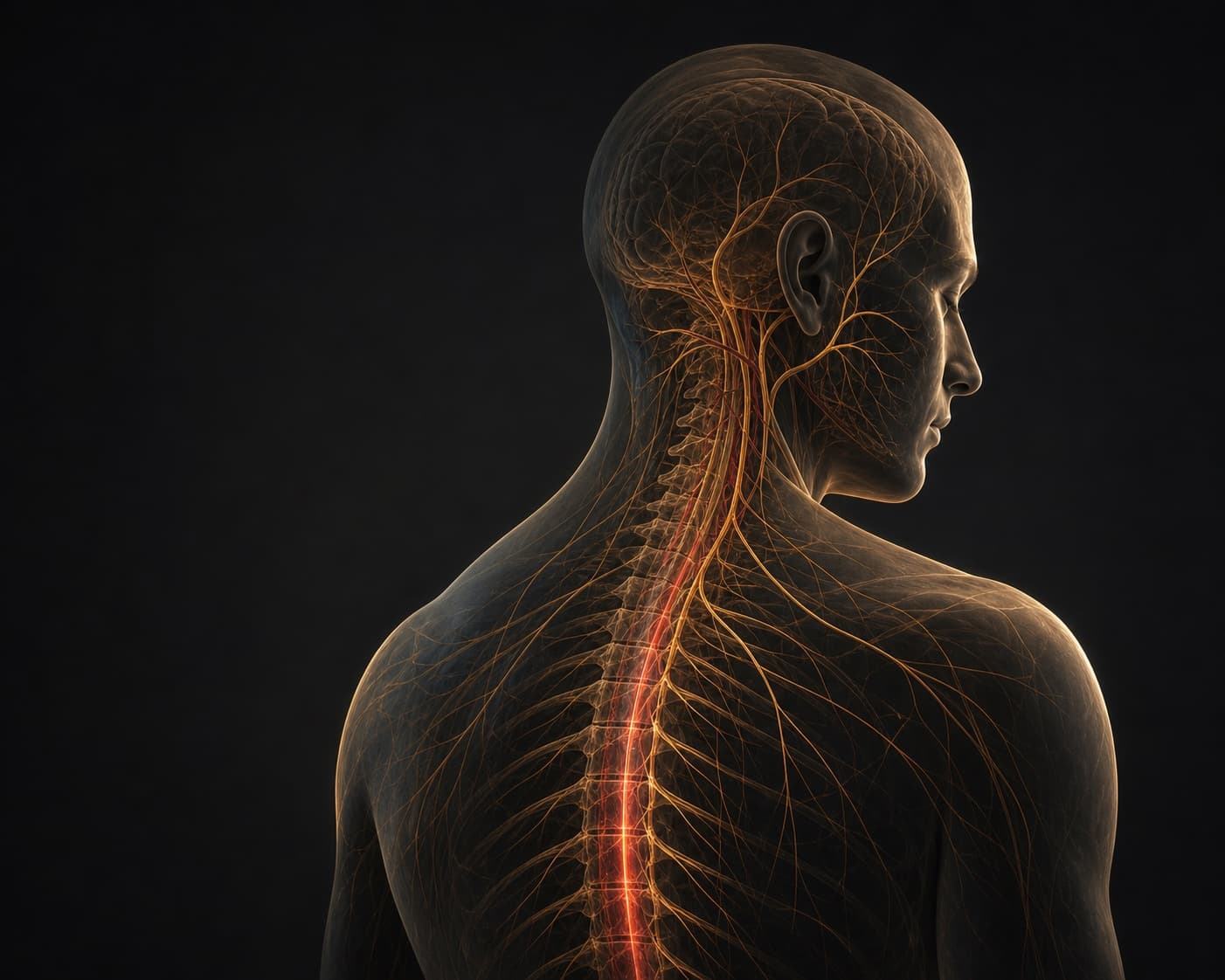
The body detects before the mind explains
The nervous system receives and integrates information before experience becomes a deliberate story. Sensory input, body state, memory, attention, and context all shape what reaches awareness and how it is interpreted. [1]
That does not mean every reaction is hidden trauma or that the body is always correct. It means perception is an active biological construction, not a neutral recording of the world.
A practical map of the system
The central nervous system includes the brain and spinal cord. The peripheral nervous system carries information between that central network and the rest of the body. Within it, autonomic pathways help regulate functions such as heart rate, digestion, breathing, temperature, and blood pressure. [1]
Sympathetic and parasympathetic activity are not simple on-and-off switches. Both participate in flexible regulation, and healthy function depends on matching state to demand.
Stress is a response, not a moral failure
Acute stress mobilizes attention, circulation, energy, and action. That can be adaptive. Difficulty arises when demands are intense, repeated, uncontrollable, or not followed by sufficient recovery. [2]
A stress response is not evidence of weakness. It is a coordinated attempt to meet perceived demand, influenced by sleep, pain, illness, relationships, work, environment, and previous learning.
Regulation means flexibility
Regulation is not permanent calm. It is the capacity to increase activation when action is needed, sustain it appropriately, and return toward recovery when the demand changes.
Slow, comfortable breathing can influence cardiorespiratory and autonomic dynamics, and structured breathing practices may reduce stress or anxiety for some people. Effects vary, and breathing should not be framed as a cure-all. [3][4]
Limits, myths, and clinical care
Claims that one technique “resets” the vagus nerve or permanently switches the body into safety usually outrun the evidence. Persistent anxiety, trauma symptoms, fainting, weakness, numbness, severe headache, or sudden neurological change require appropriate professional evaluation.
What the evidence supports
The useful signal.
- The nervous system integrates body state, sensation, memory, and context.
- Stress responses are adaptive processes, not character judgments.
- Regulation is flexible state change—not continuous calm.
- Breathing and movement may help, but universal “nervous system reset” claims are not supported.
References reviewed · July 2026