Sleep is active biology
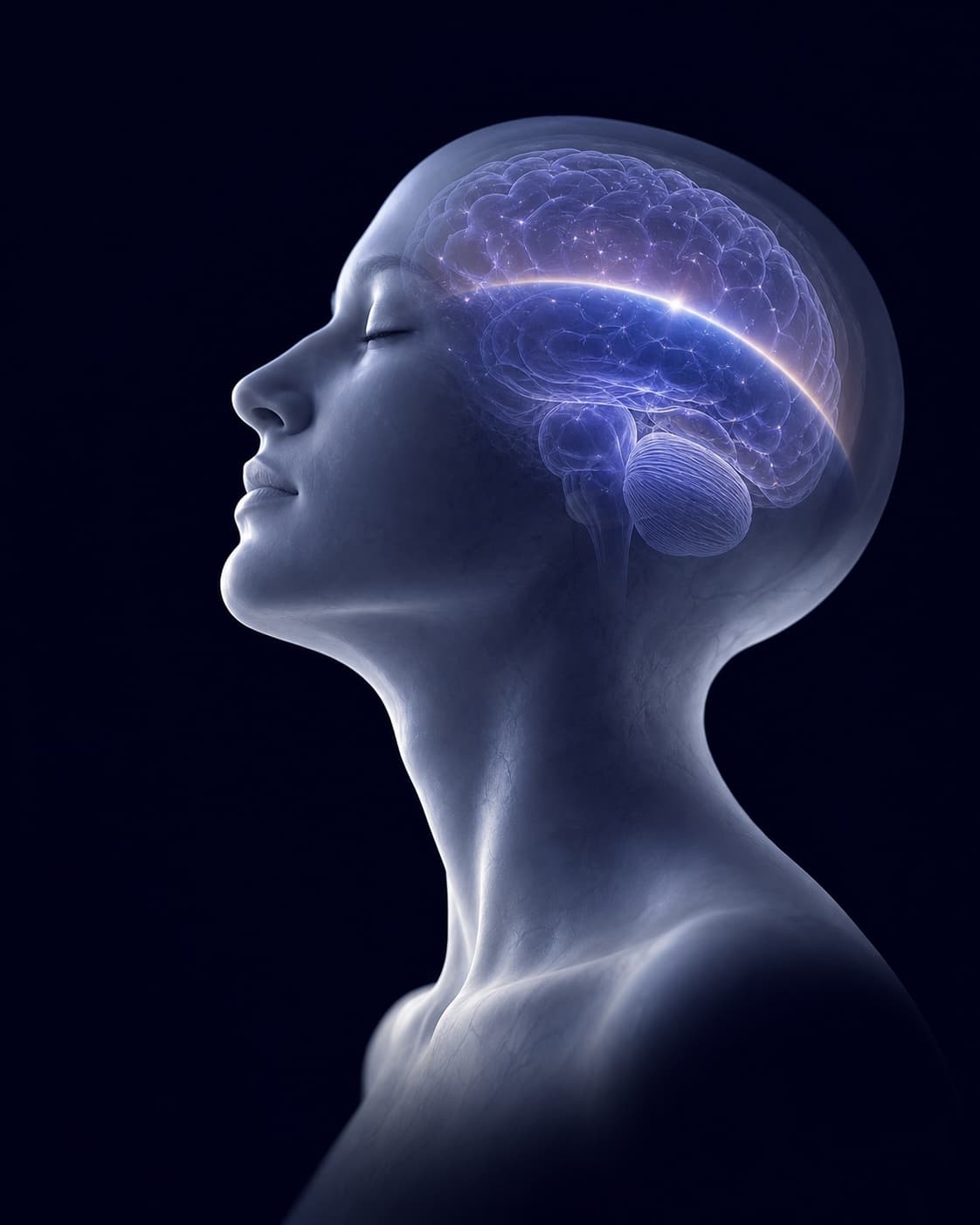
Sleep is not the absence of activity. Across the night, the brain and body move through coordinated states with distinct patterns of neural activity, muscle tone, breathing, and cardiovascular regulation. [1]
That organization matters because sleep sits upstream of many capacities people try to optimize during the day: attention, learning, emotional flexibility, training adaptation, appetite regulation, and the ability to recover from stress.
The architecture of a night
A typical night alternates between non-REM and REM sleep. Non-REM includes lighter stages and deep slow-wave sleep; REM is a distinct state in which brain activity becomes more wake-like while most skeletal muscles are temporarily inhibited. [1]
The proportion of each state changes across the night and across the lifespan. One isolated wearable score cannot capture the full quality or clinical meaning of that architecture.
Timing and sleep pressure work together
Two interacting processes help explain when sleep becomes likely: a homeostatic pressure that builds with time awake, and a circadian system that organizes sleep and wake around roughly 24-hour timing. [2][3]
Light, schedule, travel, shift work, caffeine, and individual biology can change how those processes align. This is why sufficient time in bed can still produce poor sleep when timing is repeatedly out of phase.
Practical interpretation
The fundamentals are unglamorous and powerful: protect enough sleep opportunity, keep wake time reasonably consistent, use morning light to anchor the day, reduce disruptive evening light, and make the sleep environment dark, quiet, and comfortable.
Tracking can help reveal schedule patterns, but chasing perfect stage percentages often creates more noise than insight. The useful question is whether a measurement changes a sensible decision.
When sleep needs clinical attention
Persistent insomnia, loud snoring with breathing pauses, gasping during sleep, severe daytime sleepiness, or sleepiness that creates driving or workplace risk deserve professional assessment. Sleep apnea and other disorders cannot be ruled out by motivation, supplements, or a consumer wearable. [4]
What the evidence supports
The useful signal.
- Sleep is a regulated physiological process, not passive downtime.
- Sleep pressure and circadian timing interact; duration is only part of the picture.
- Consistent timing, adequate opportunity, light exposure, and environment are practical first levers.
- Persistent or safety-relevant symptoms require clinical evaluation.
References reviewed · July 2026
Sources
- 01How Sleep Works: Sleep Phases and StagesNational Heart, Lung, and Blood Institute · 2022
- 02How Sleep Works: Your Sleep/Wake CycleNational Heart, Lung, and Blood Institute · 2022
- 03The two-process model of sleep regulation: a reappraisalJournal of Sleep Research · 2016
- 04Sleep Apnea: SymptomsNational Heart, Lung, and Blood Institute · 2025